2026
St. John of God, Murdoch
Entry Statement with programmable lighting
Hesperia
Hassell
Capital House Engineering
34 fins, 4.4m high down to 1.4m
Steel with Liquid metal alloy brass with heat patina
$730, 000
Kilmore Group
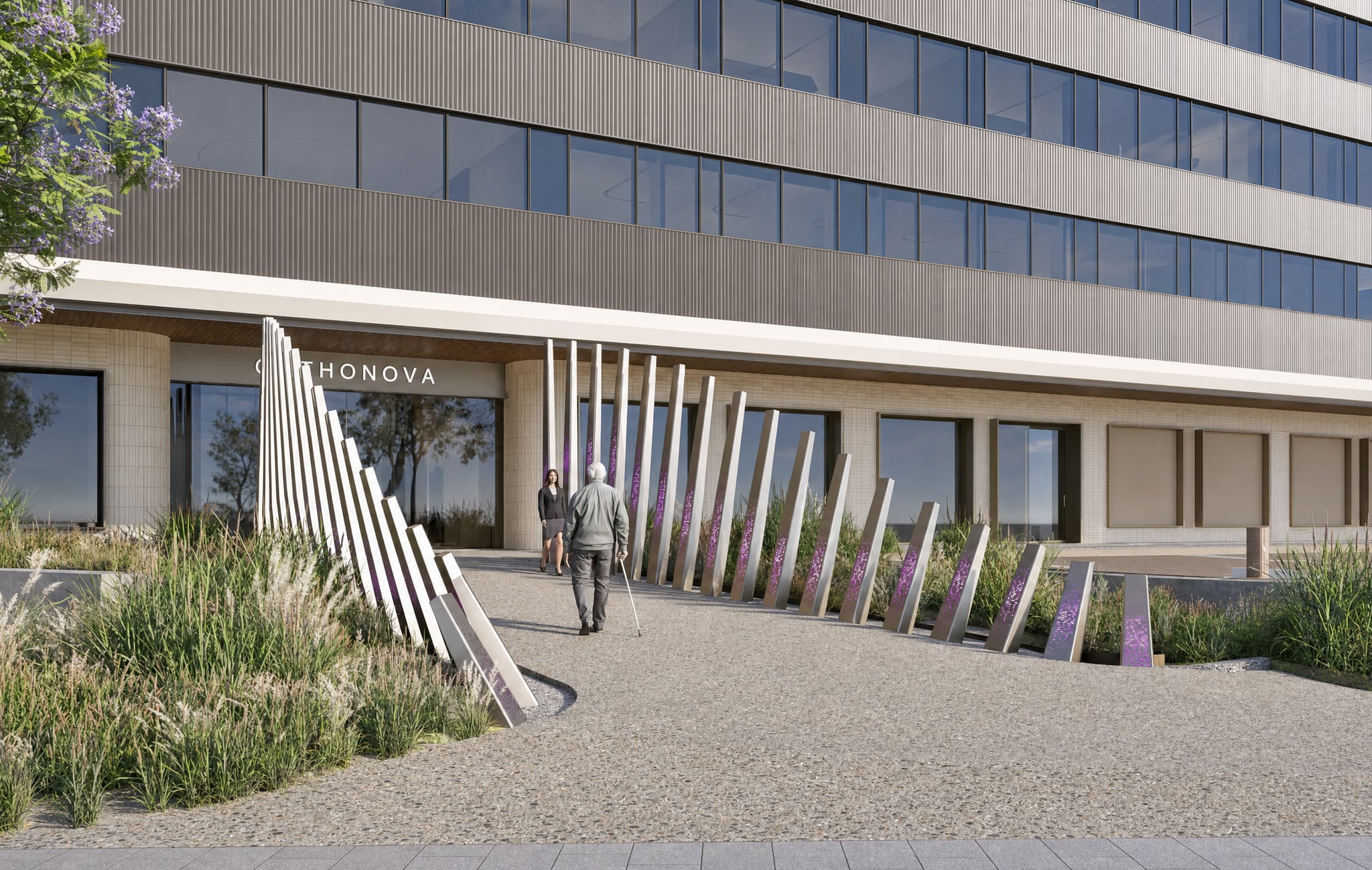
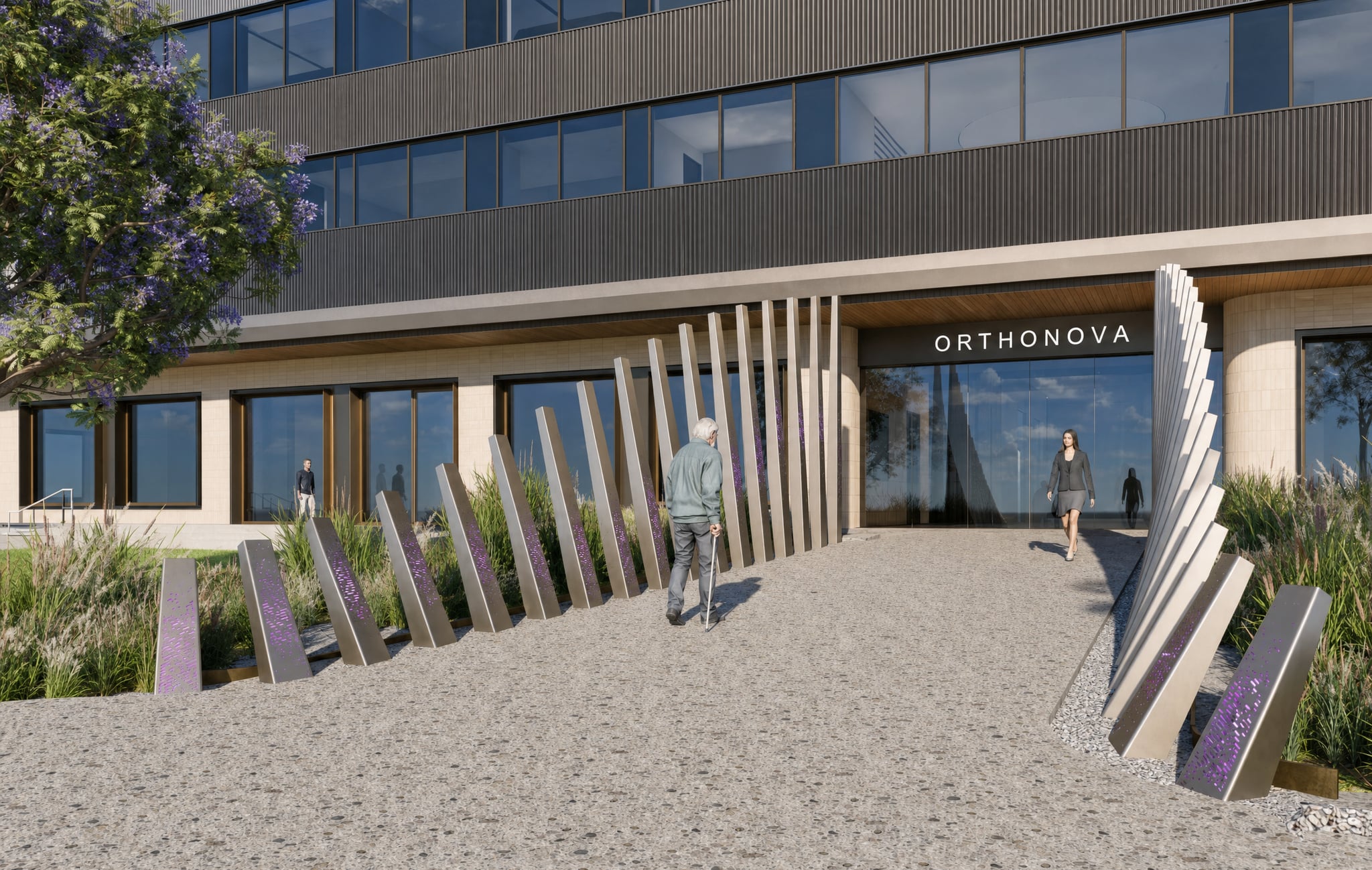
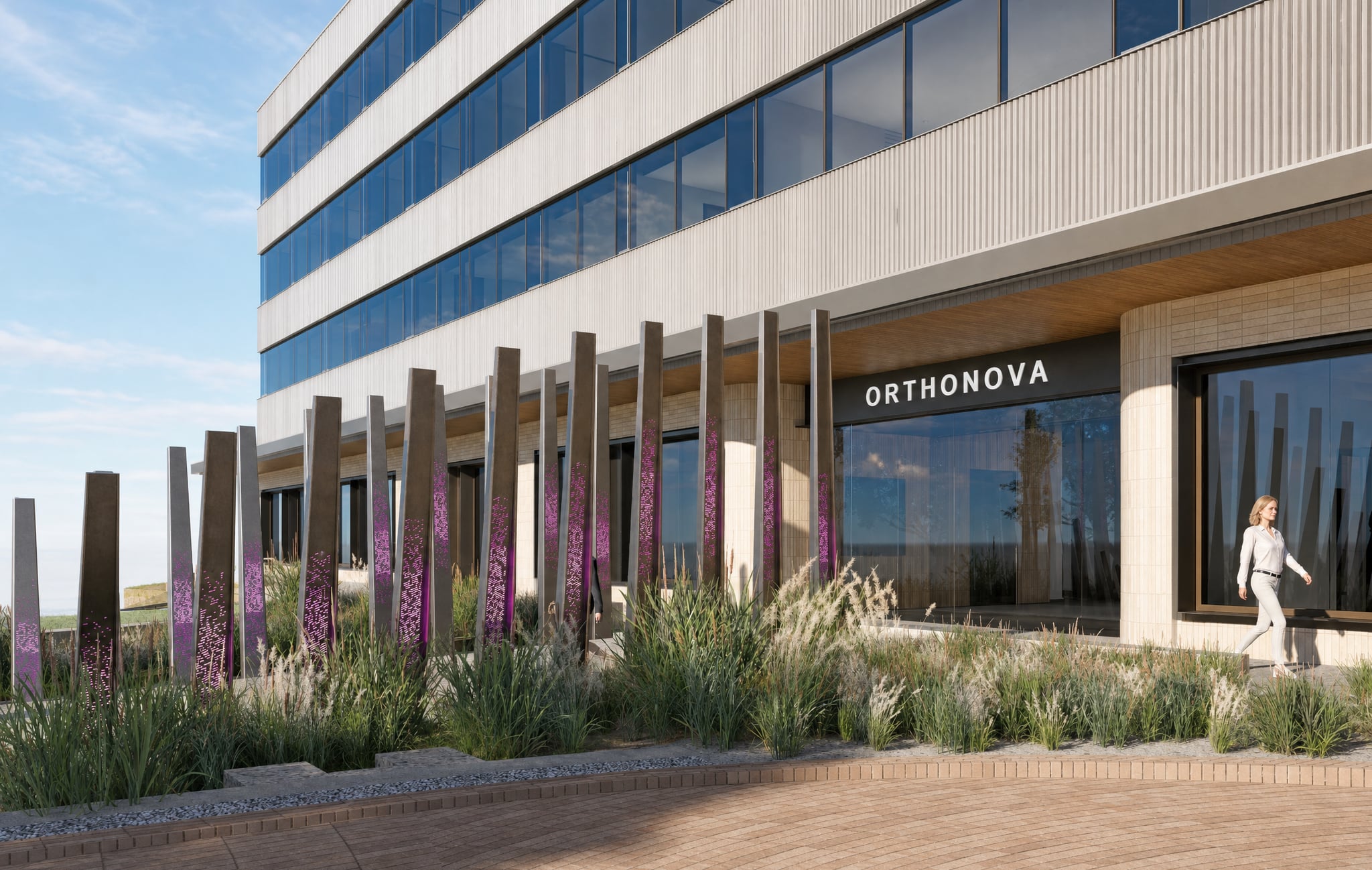
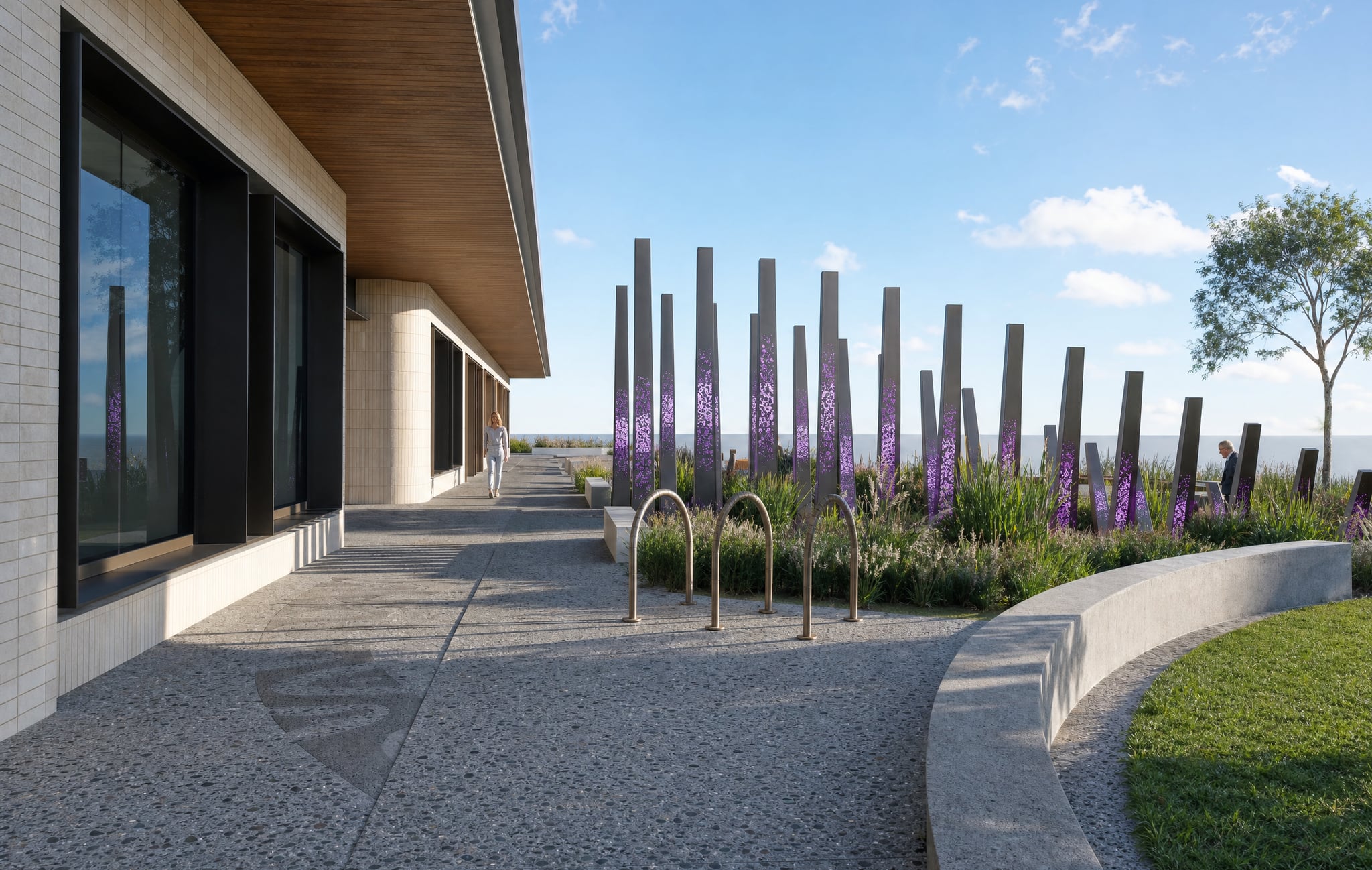
A procession of champagne-brass painted fins that leans, straightens and stands tall at the hospital door, performing the recovery it welcomes you toward.
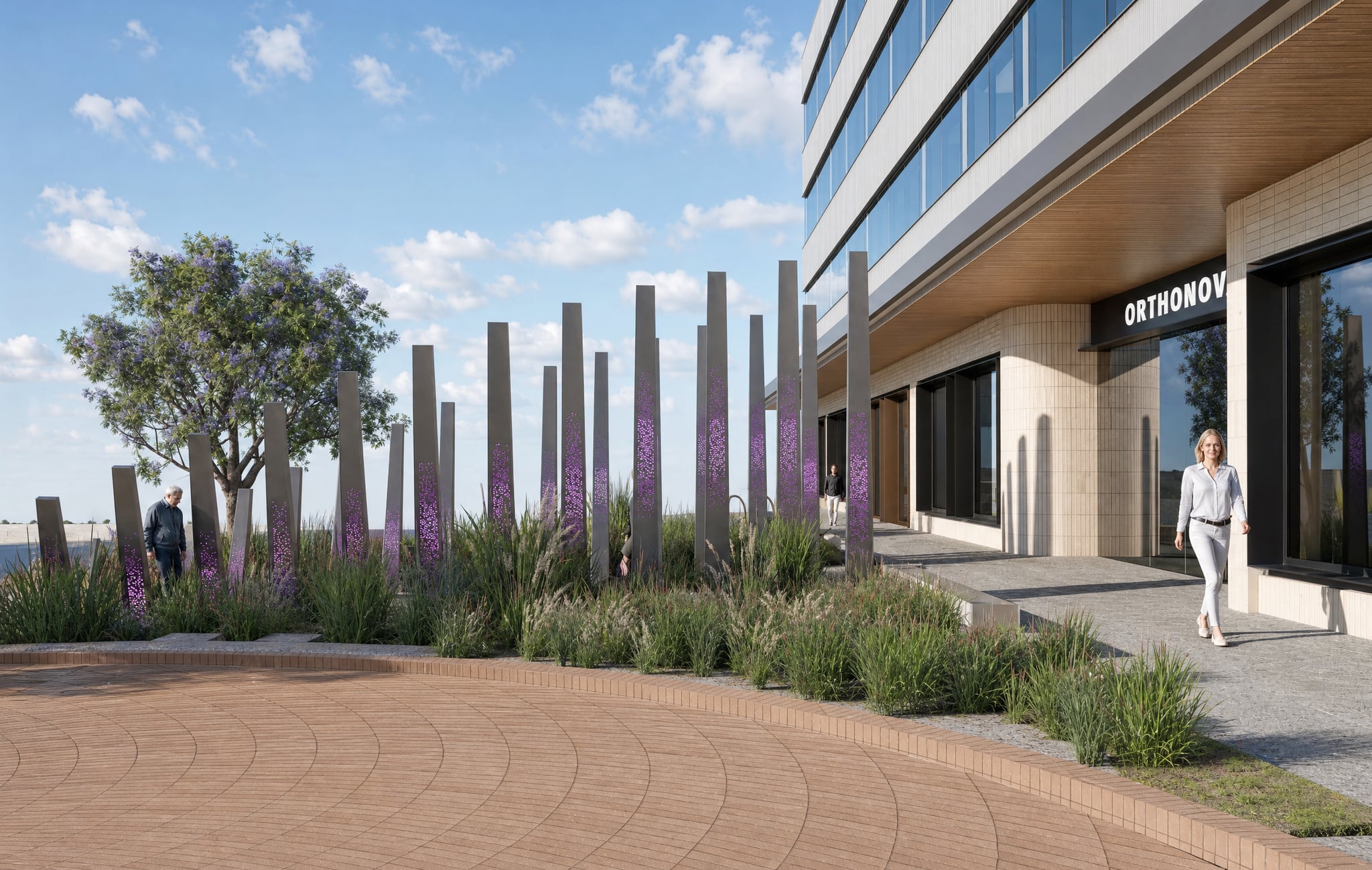
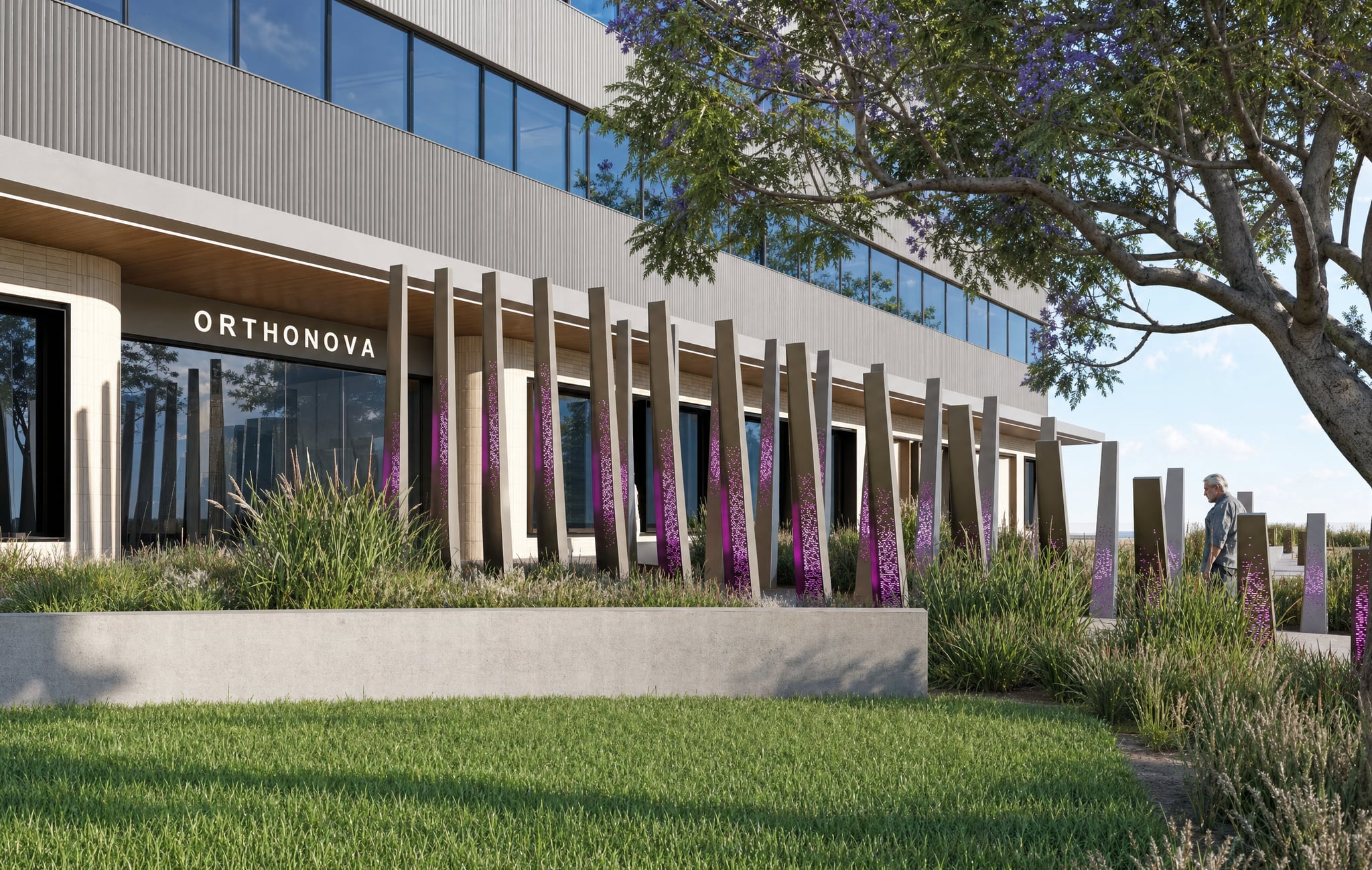
At the entry to Orthonova, a new orthopaedic facility in the Murdoch Health and Knowledge Precinct, a procession of bronze fins rises along the approach path, and as the fins near the door they change. At the far ends of the sequence they lean, tilted off the vertical; step by step toward the entrance they grow taller and straighter, arriving at a stable right angle beside the building. The artwork performs the very journey the building exists for: it begins bent and ends upright. Broken, in pain and needing treatment at one end; healed, regenerated and standing tall at the other.
The concept explores regeneration, journey and convergence. Regeneration is the process of renewal and tissue growth that makes organisms and ecosystems resilient to damage, the daily work of the hospital behind the artwork. The journey carries the visitor from one state to another, its directionality doubling as wayfinding, guiding arrivals from the carpark and the building's flanks toward the entry. And convergence is the place where currents meet: the fins gather together as they approach the door, a meeting point for people and ideas, the way water currents have always drawn people together on this country.
Water runs deeper still in the work's perforations. This is Beeliar country, where each moort (clan) followed bidi (foodlines) connecting the coast to the chain of wetlands inland, and where Noongar stories tell of the Waakal, the Rainbow Serpent, weaving from Fremantle to Mandurah, shaping the Boodjar and the foundation for life in the area. Voids cut through the fins' surfaces articulate movement and connectivity, currents and flows, reading as the meandering water bodies of the Beeliar wetlands and, at the same time, as the flows within the body itself, the internal processes of living systems that allow for healing and regeneration. One pattern, two rivers: the landscape's and the body's.
The materiality is bone. The 8 mm custom pressed and perforated steel fins are finished in a bronze and copper sand cast Metalcote skin, chosen because its granular texture recalls bone seen through a microscope, while the bronze ties the artwork into the building's architectural palette. Within the fins, one hundred linear metres of individually addressable LED lighting, synchronised with the building's management system, plays slow programmable sequences after dark, developed to evoke calm and tranquillity rather than spectacle: a gentle beacon marking the entry, with all components accessible for maintenance through removable rear panels.
The journey begins underfoot. In collaboration with Nyoongar artist Sharyn Egan, whose practice spans painting, sculpture and woven forms grounded in her life as a Nyoongar woman, drawings of flow lines, river and water are sandblasted into the coloured concrete of the entry path, some seventy five square metres of pattern revealed as exposed aggregate within the floated surface. Her marks carry the ground story the fins carry in the air, so that a visitor walks the water on the way to the door.
Set on streets named for Fiona Wood and Barry Marshall, in a precinct built around healing, the artwork offers arriving patients the quietest kind of encouragement: a form that has made the journey ahead of them, and stands at the door, upright.