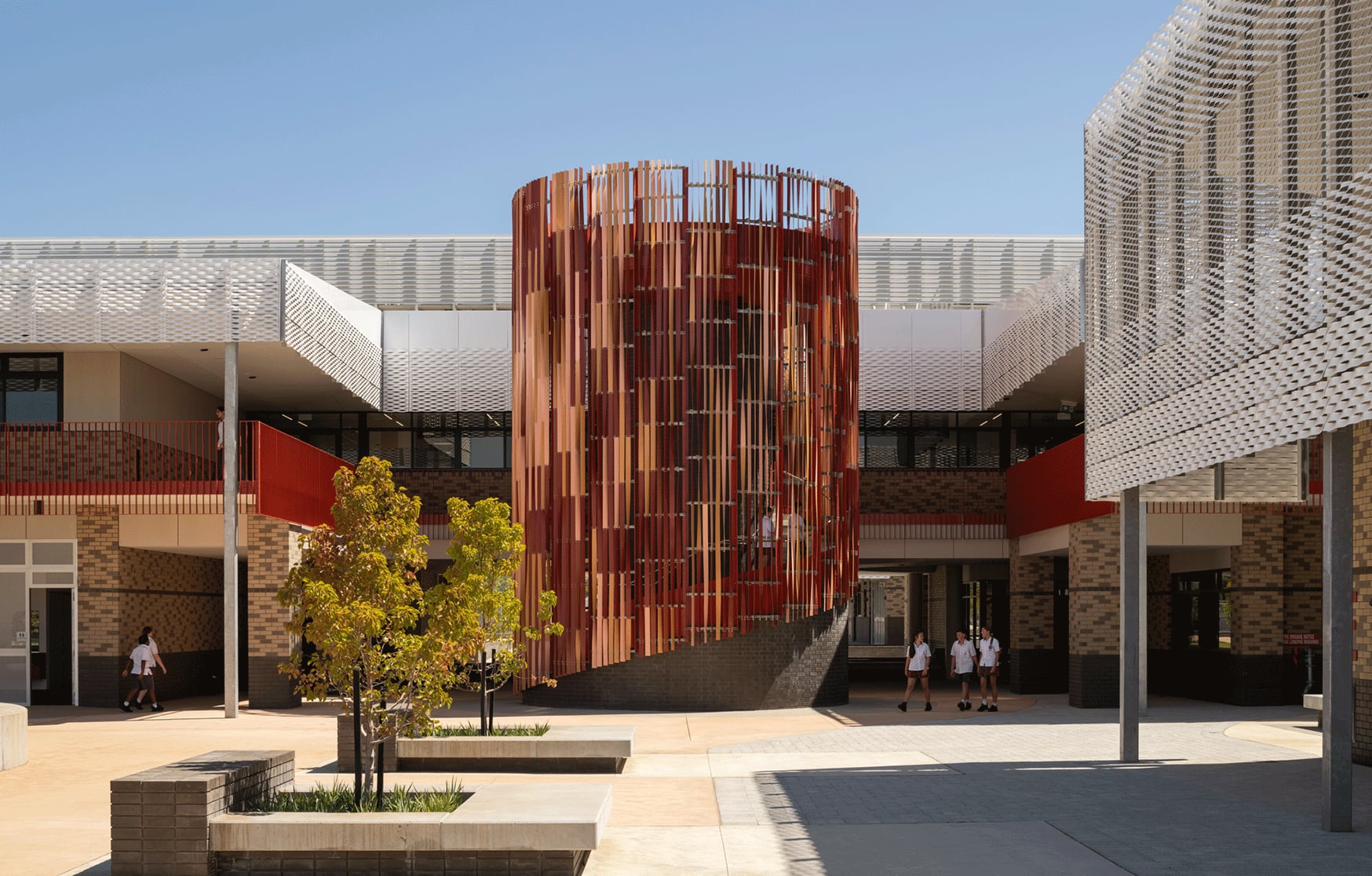
Schools are the most demanding sites the studio works on, and the most rewarding. The audience is fifteen hundred people who did not choose to be there, who will pass the artwork two thousand times before they leave, and who will test every surface, edge and foothold it offers. Four secondary colleges for the Department of Finance, at Yanchep, Piara Waters, Carine and Alkimos, have taught the studio what an education site asks of an artwork. Here is the list.
It has to survive being ignored
A school artwork is not visited. It is passed, daily, at speed, by people thinking about something else. Anything that depends on stopping to look will be invisible by the second week. The works that hold up are the ones that change: a surface that reads differently at eight in the morning and three in the afternoon, from the bus bay and from the stair, in Year 7 and in Year 12.
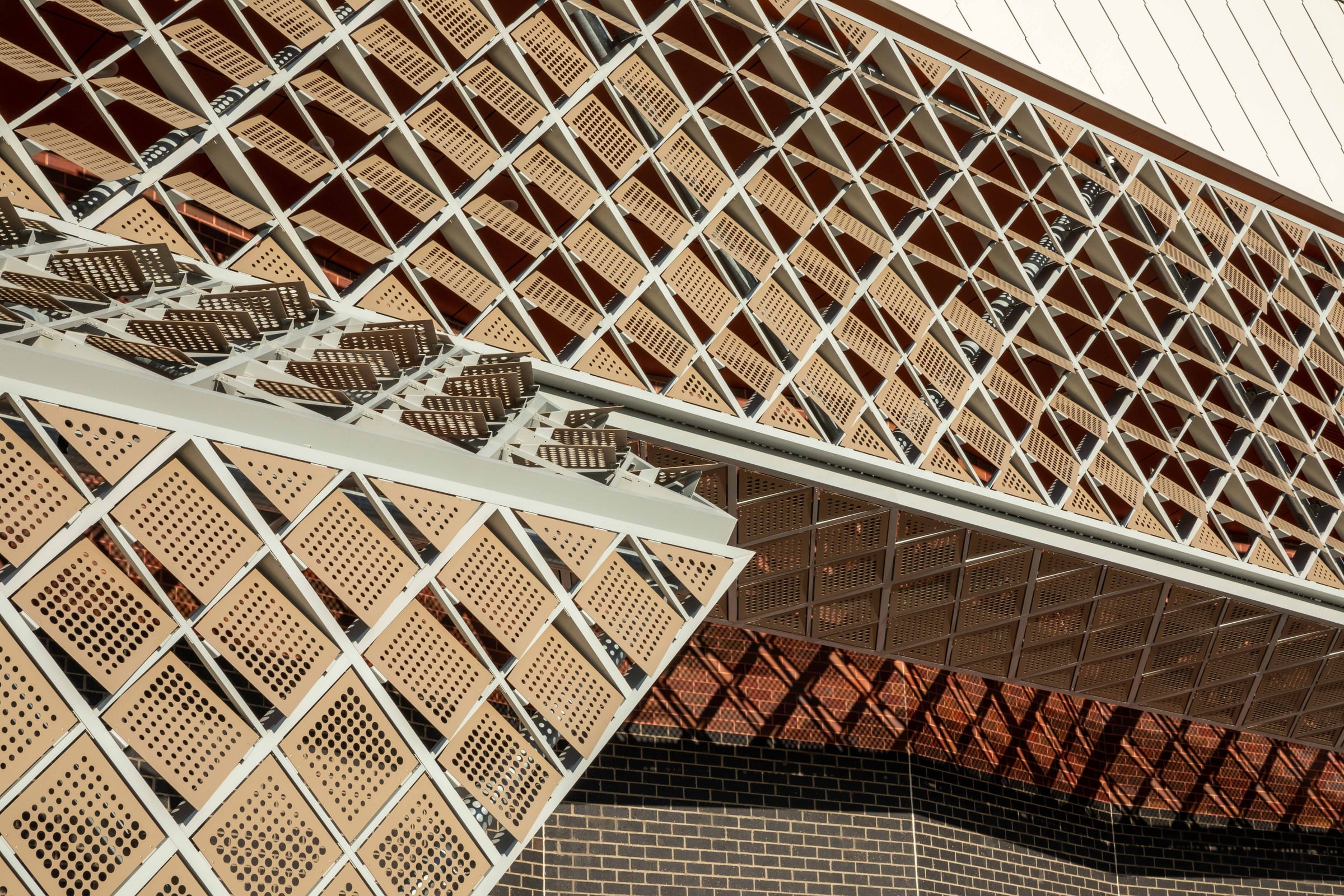
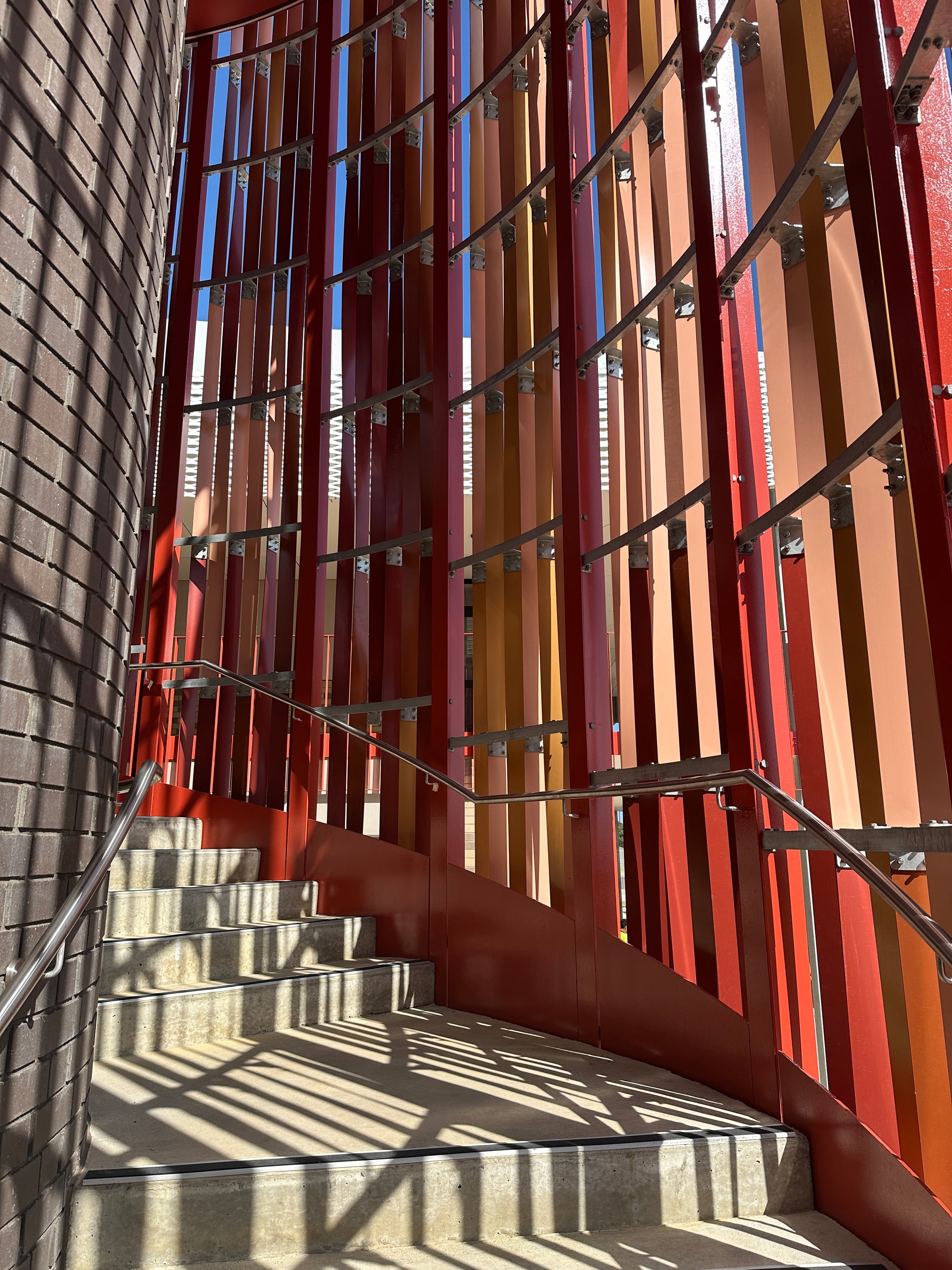
At Piara Waters Secondary College, Anthesis wraps the two stair towers in twisting aluminium fins set by a parametric grid. The surface has no moving parts, but it needs the viewer to complete it: with every stride past the towers, the fins realign and the pattern ripples. A student climbs those stairs several times a day for six years and the artwork is never quite the same twice.
It has to survive being touched
Everything at a school gets touched, leant on, climbed, kicked and, occasionally, tested to destruction. The response is not to put the artwork out of reach, which makes it a decoration, but to design for contact.
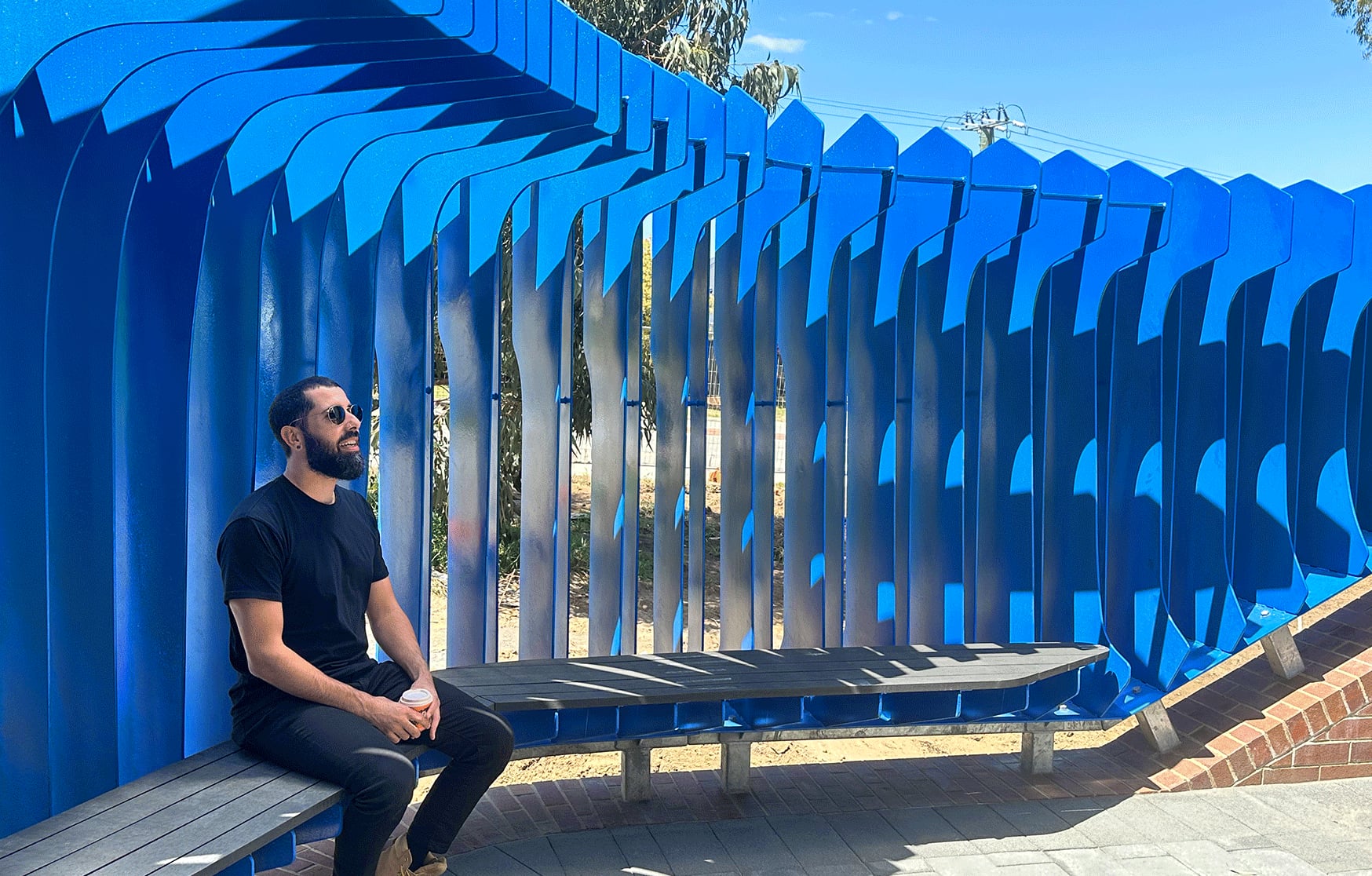
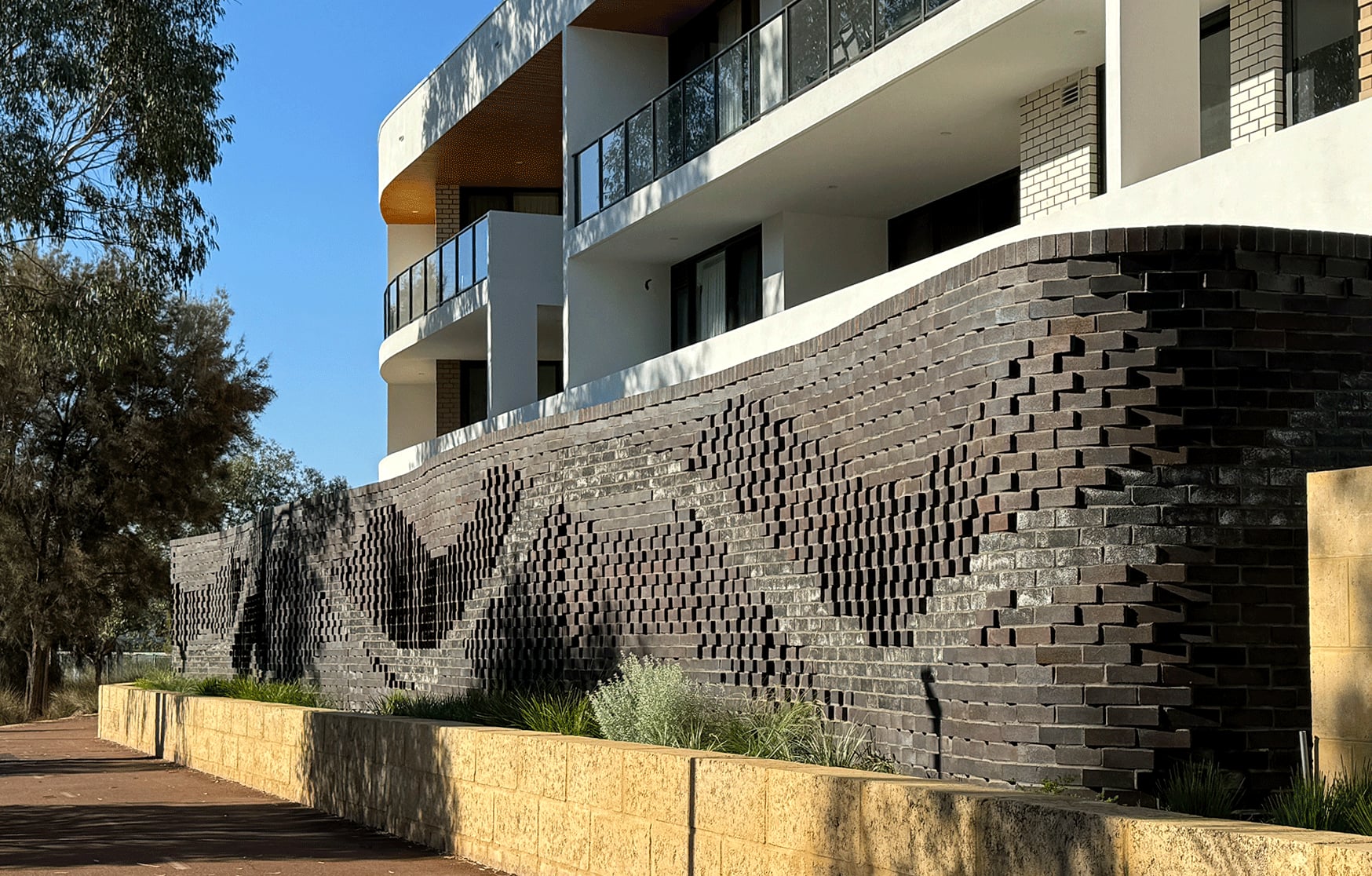
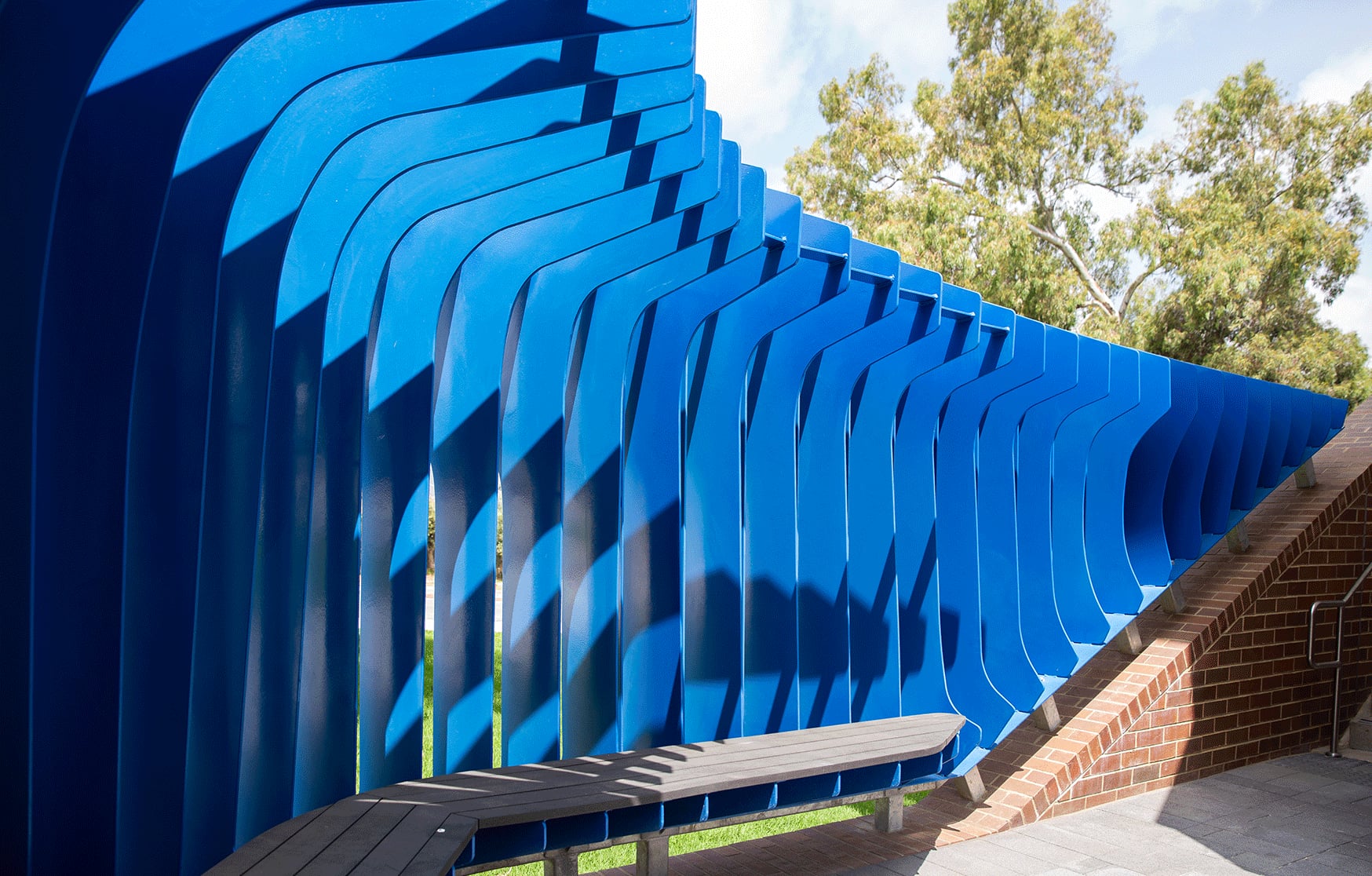
Brick relief at Yanchep lives in rotation rather than applied finish, so there is nothing to peel or chip. The pleated brickwork at the Stage 2 building has a quieter practicality: it resists climbing. Fin screens are spaced and fixed against the loads a teenager can apply, and their brackets are engineered rather than assumed. The Exchange at Carine is the extreme case, a fence, a bench and a canopy in one folded form, built to be sat on, gathered under and passed along every day, with the school's security boundary folded into the sculpture rather than fenced around it.
It has to do a job
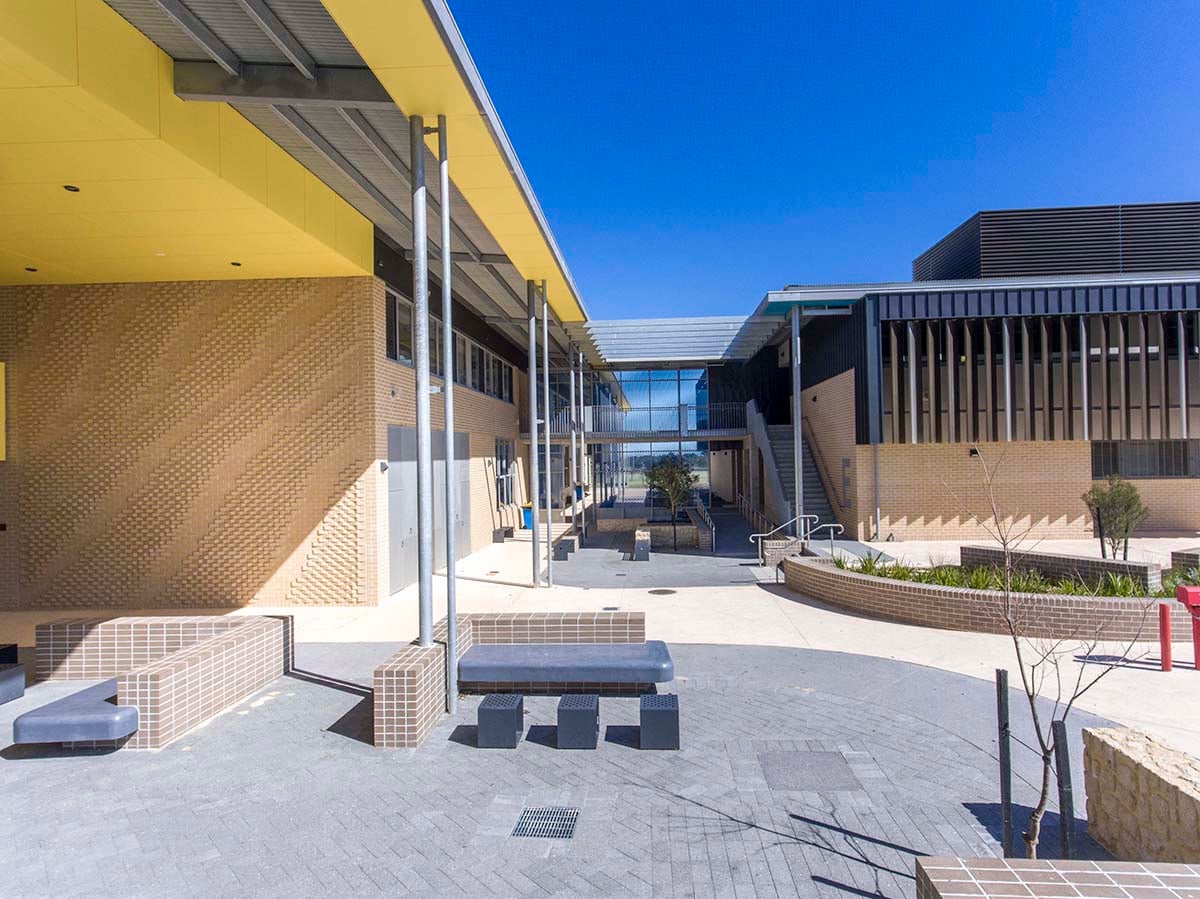
School budgets are tight and school buildings have long lists of things they need. The artworks that work hardest are the ones that take an item off that list. At Yanchep the artwork is the shade louvres, the feature brick walls and the printed glass windbreaks, surfaces the school had to build anyway. At Alkimos College, Windswept is the sunscreen and public face of the Performing Arts Centre. At Carine the artwork is the boundary. The earlier post on art that does a job goes into how that is set up.
It has to belong to the place
A new school on a greenfield site is usually the first civic building its suburb has had. The artwork is a chance to tell the students what was there before the streets. Piara Waters takes its name from the candlestick banksia that grew in open woodland across the ground; Anthesis draws its palette from the banksia's flowering spikes and its geometry from the spiral of its seed pod. Yanchep and Alkimos draw on the coast their students grow up on: the dune ripples, the swell, the wind. None of it is a lesson. It is a reason to look.

It can become the school's identity
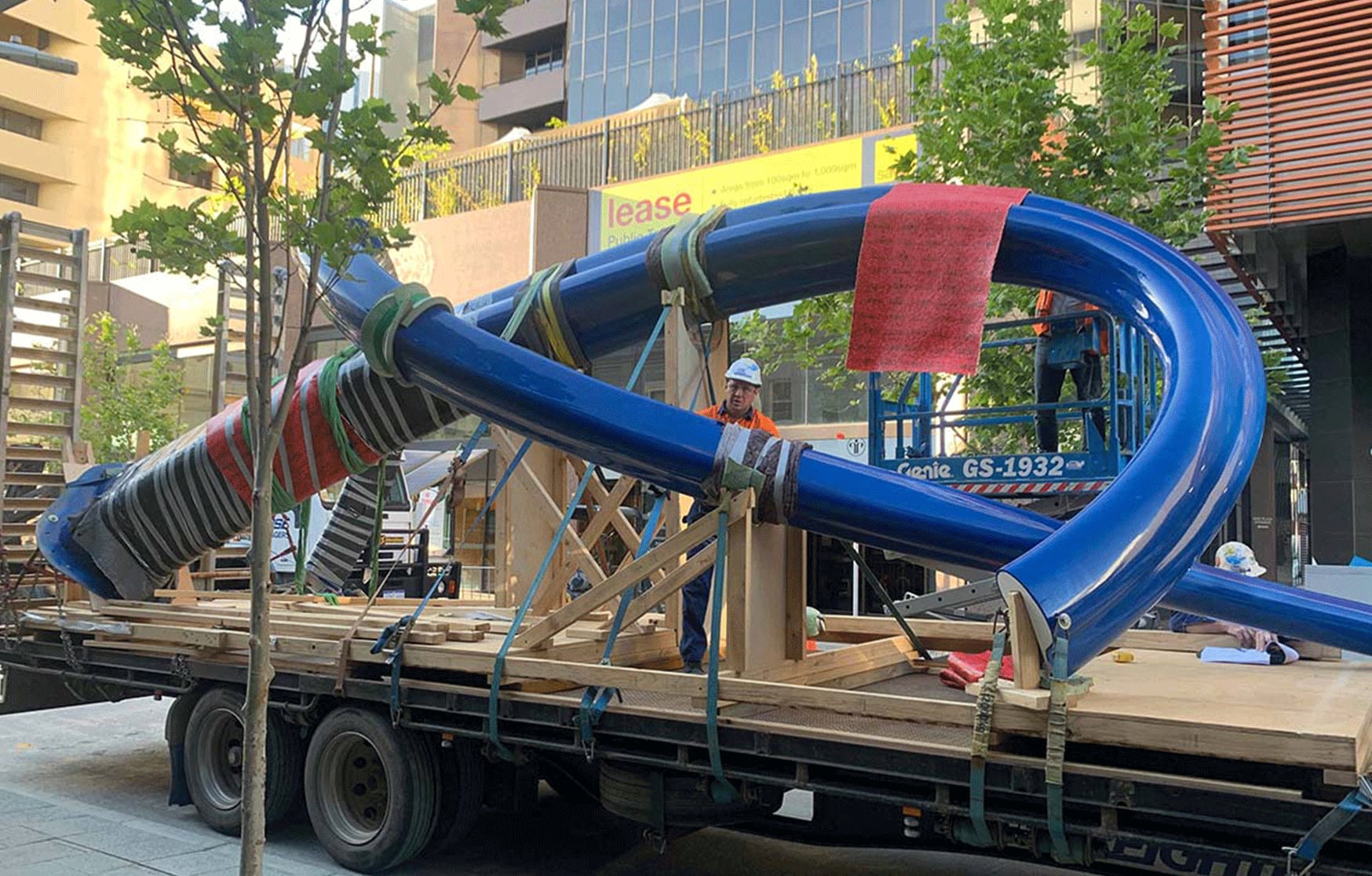
Something unusual happened at Piara Waters. After Anthesis was built, the school adopted it: the school's logo is drawn from the helix of the stair tower, and its stated vision describes the upward spiral as the pathway that takes every student into the future. When the Stage 2 building came, the brief asked the studio to grow from that identity in return. Inflorescence is three painted steel sculptures at three stages of bloom, Junior rising, Middle School prospering, Senior flourishing, placed along the campus so that the journey toward maturity is mapped onto the ground the students cross.
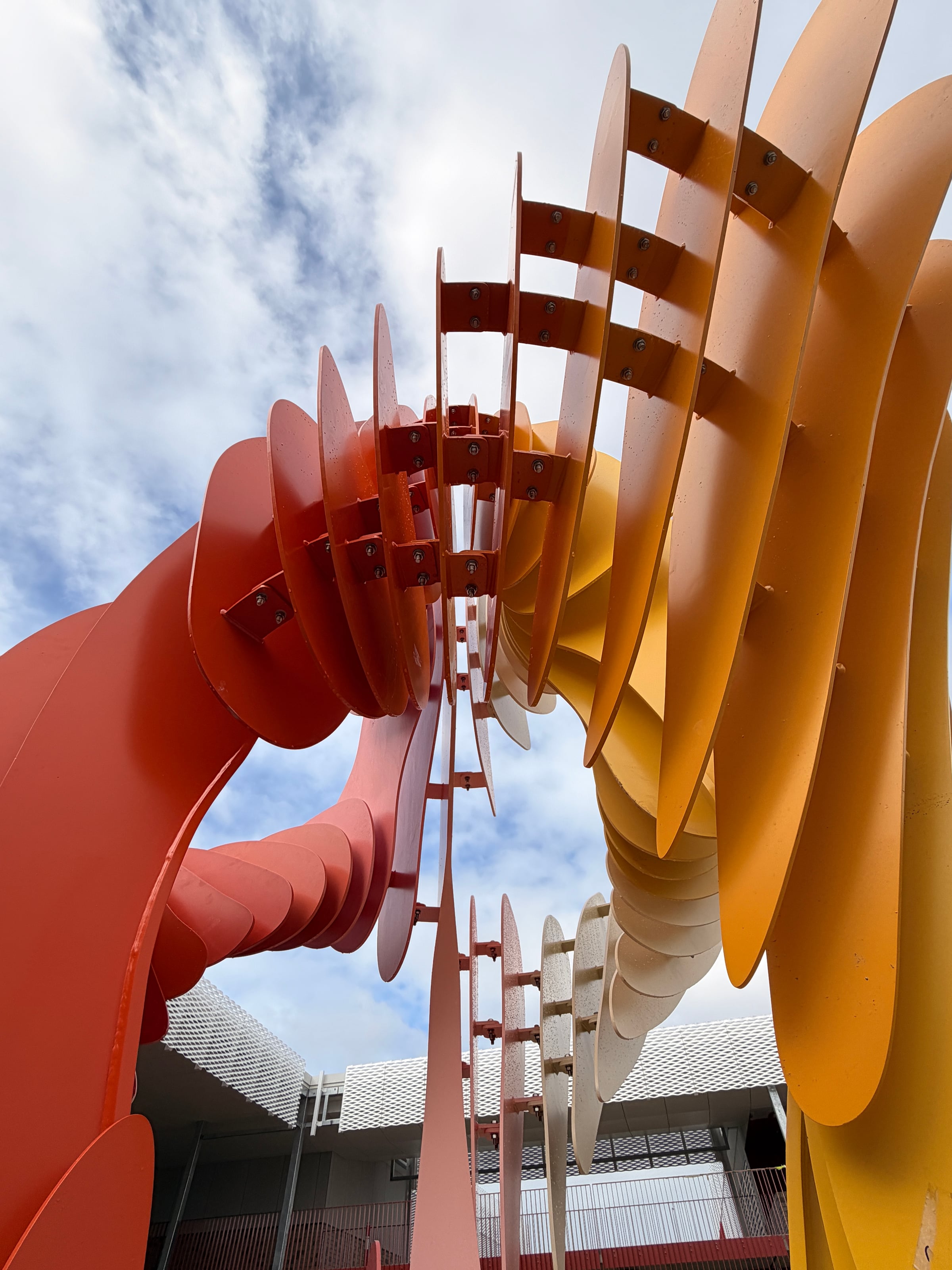
That is the best outcome a school commission can have: an artwork the students do not think of as art at all, but as the thing that makes their school theirs.
What a school project needs from its commissioner
Early engagement. Schools are delivered on fixed programs with little slack. The Department of Finance's Percent for Art process brings the artist in during design, which is what allows the artwork to become louvres, walls and screens rather than an object added at the end.
A brief that names the job. If the artwork can be the shade, say so. If it can be the fence, say so. The budget goes further and the school gets a building rather than a building plus an object.
A maintenance conversation. Schools have facilities staff, not conservators. Materials are chosen to be cleaned with what a school owns, and the handover folder tells them how.
Trust in the audience. Teenagers are the most honest critics there are. Design something that rewards them for looking twice, and they will.
See the school works in the work index, or get in touch about an education site.